THE BIOLOGY
Editor’s note: On March 26, 2012, James Cameron made a record-breaking solo dive to the Earth’s deepest point, successfully piloting the DEEPSEA CHALLENGER nearly 7 seven miles (11 kilometers) to the Challenger Deep in the Mariana Trench. DEEPSEA CHALLENGE is now in its second phase—scientific analysis of the expedition’s findings.
At the frigid bottoms of Earth’s ocean trenches, scientists have discovered life-forms where they once thought none could survive. From gelatinous animals called holothurians to shrimp-like creatures named amphipods, the animals of the deep can quickly start to resemble alien beings.
James Cameron saw his share of the bizarre and otherworldly while he explored the ocean bottom on the DEEPSEA CHALLENGE expedition. Now, scientists are hard at work trying to understand, classify, and learn from the deep-sea dwellers that the expedition carried—via collection vessels or images—into our above-water world.
NEW SPECIES IN THE CHALLENGER DEEP?
Immediately following the expedition, there was a talk of new species. A gray, crayon-size holothurian, or ‘sea cucumber’ captured on camera at nearly 7 miles (11 kilometers) deep looks different from anything biologists have ever seen before, said Natalya Gallo, a doctoral student who has been studying hours upon hours of expedition footage from a lab at Scripps Institution of Oceanography. The DEEPSEA CHALLENGER navigated past the sea cucumbers during the Challenger Deep dive, but Gallo only spotted them when she noticed a slight disturbance in the normally smooth sediment on the bottom.
“It looks kind of like a fat worm with long feeding appendages,” Gallo said. Perhaps most noteworthy is the way it appears to feed: The sea cucumbers orient their bodies identically, almost like soldiers, so that the deep-sea current will deliver food particles to their feeding tentacles. They can’t be officially confirmed as a new species, however, without physical samples.
At the Challenger Deep, the expedition also captured images of abundant xenophyophores—single-celled organisms that can grow as big as saucers—the largest of which was only discovered one year prior to the DEEPSEA CHALLENGER Expedition.
“All in all it shows that even in the deepest parts of the ocean, life can survive quite well,” Gallo said.
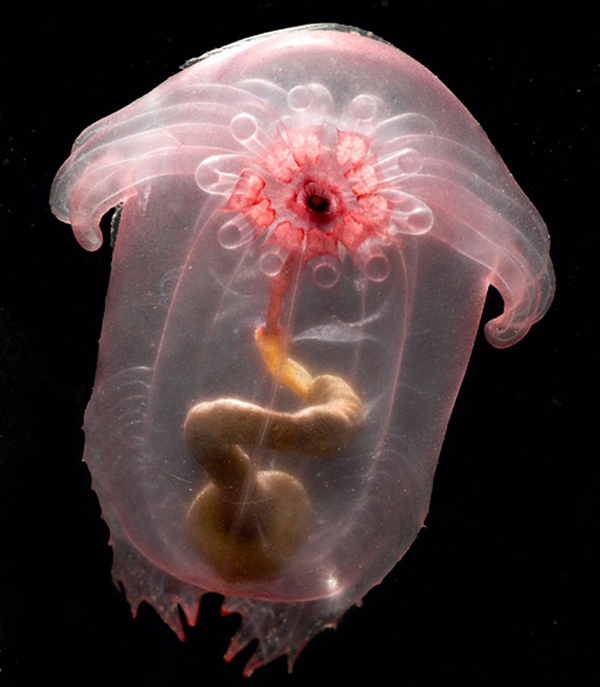
Photograph courtesy Census of Marine Life
This see-through sea cucumber, dubbed Enypniastes, was spotted at depths of about 1.7 miles (2.7 kilometers) during a 2009 expedition in the northern Gulf of Mexico, scientists say.
BIODIVERSITY ABOUNDS IN THE NEW BRITAIN TRENCH
While talk of the expedition tends to focus on Cameron’s history-making dive in the Challenger Deep, scientists are buzzing about the biodiversity the team found in a different deep-ocean zone: the New Britain Trench. It’s smaller than the Mariana Trench, which is home to the world’s deepest point, but the New Britain Trench still plunges to a depth of more than five miles (eight kilometers) off the coast of Papua New Guinea. Its position close to land and amid food-carrying currents creates an environment more conducive to life.
There as well, scientists have analyzed images of never before seen species. With small tentacles, a whitish color, and an undulating swimming style, a jellyfish repeatedly spotted at 8.2 kilometers down may be the deep sea’s answer to moon jellyfish, which are typically found close to the surface in coastal areas.
At that depth, the expedition also picked up amphipod specimens. They so closely resemble shrimp that the expedition’s chef joked he wanted to serve them for dinner, but these creatures, which measured more than 7 inches (18 centimeters) long, are the deepest examples of “gigantism” captured in the deep ocean, said Doug Bartlett, chief scientist on the expedition. Cameras picked up images of still larger amphipods—an estimated 12 inches (30 centimeters) long—but they were too big to fit in the baited trap that brought the others to the surface. Once taxonomy has been completed as many as four of the bunch collected, may be new species.
At five miles below the surface, Cameron navigated the sub past anemones, which grow on long stalks anchored to rocks and resemble deep-sea daisies.
While exploring other depths in the New Britain Trench, still different habitats emerged. At 12,300 feet (3,750 meters) below the surface, the expedition found deep-sea lizardfish, eelpout, octopus, and a seafloor etched with lines and squiggles. Called rosettes, the markings are actually created by the proboscises of spoon worms. These creatures, which look something like flat earthworms, can range from drab to vivid colors—turquoises and greens—but spend much of their time submerged in holes they’ve bored in the sediment. To feed, they poke their proboscises out their holes and hope some food—typically plankton or other organic matter—has settled nearby.
Even at 3,280 feet (1,000 meters) deep, the New Britain Trench put on a biological show. There, Cameron may have been the first in the world to see a particular type of squid worm. A swirling ribbon of an animal covered in neatly arranged paddles, the creature he spotted may even represent a new species in a genus that was only first described in 2010. But to be sure, researchers will need to go back and get a sample.
AMPHIPODS AND ALZHEIMER’S
Amphipods discovered at the bottom of the New Britain Trench, harbor an intriguing compound with a complicated name: scyllo-inositol. Before the expedition, this substance, which is also found in coconut palm sugar, was already being studied for its potential to treat Alzheimer’s. Researchers hope scyllo-inositol could help inhibit the accumulation of amyloid plaques on the brain, a hallmark of Alzheimer’s disease. In the deep-sea, it may help amphipods survive under thousands of pounds of pressure per square inch of their bodies.