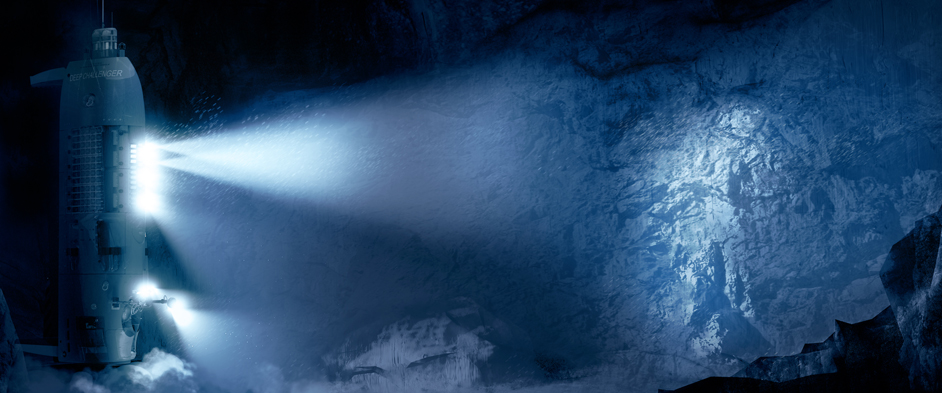
The deepest parts of the ocean are the least explored places on our planet. Immense water pressure and a complete absence of sunlight make this environment nearly as unwelcoming as outer space. Yet locked in these dark depths could be clues that will help us better understand our world.
When the DEEPSEA CHALLENGER dropped nearly 7 miles (11 kilometers) to the Challenger Deep in the Mariana Trench, its mission was one of scientific exploration and discovery, part of an expedition designed to help scientists study some of the least explored places on our planet. Immense water pressure and a complete absence of sunlight make this environment nearly as unwelcoming as outer space, and yet scientists hoped that the expedition would bring back clues to help us better understand our world.
The results did not disappoint. Scientists across the country are still poring over images, caring for cultures, and examining deep-sea DNA as they try to learn more about how the biological and physical sciences look and operate in the ocean’s depths. Research ranges from searching for new species and studying compounds that help animals stand up to crushing pressures to examining temperature and pressure readings from miles down.
The DEEPSEA CHALLENGER was equipped with a hydraulic manipulator arm for taking samples and with multiple cameras for capturing images of the landscape and life-forms in some of the world’s deepest zones. It worked in tandem with a lander, an unmanned, phone-booth-size vessel that was also deployed to the mysterious depths to collect specimens and images.
While Cameron’s record-breaking Challenger Deep dive was the most talked about part of the expedition, scientists are also eagerly working with the images and samples that he brought back from other parts of the deep ocean. The New Britain Trench off the coast of Papua New Guinea provided a trove of samples and images that might represent new species. Scientists are also working with data gathered in the Sirena Deep, another plunging underwater canyon in the Mariana Trench.
Explore the biology and geology pages to learn more about the ongoing research and the science of the deep.
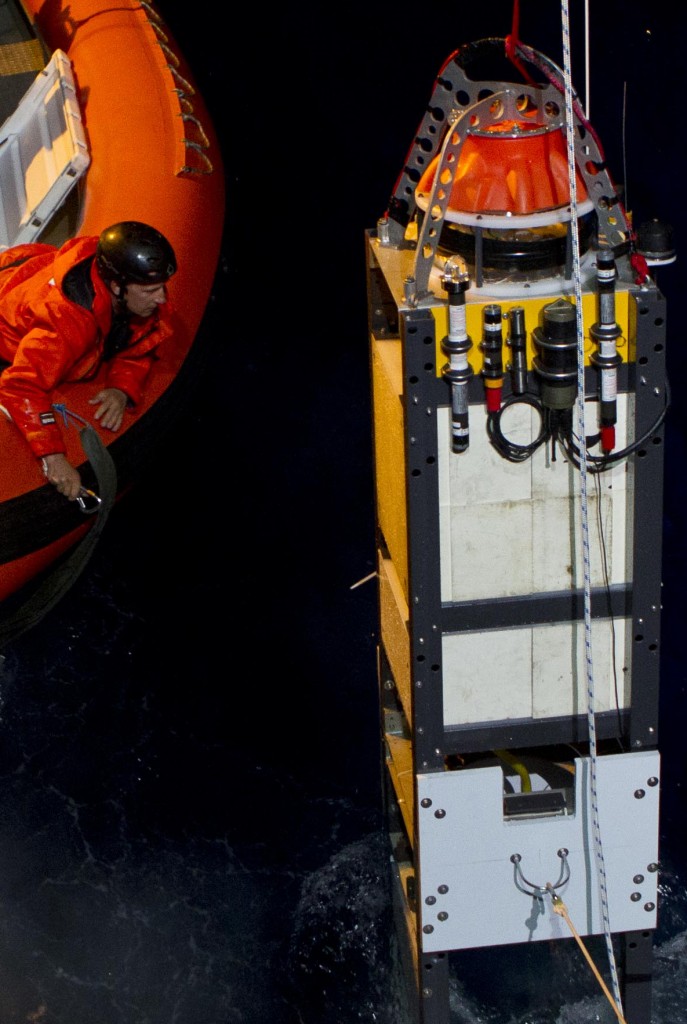
Photograph by Mark ThiessenThe crew tests one of two unmanned landers that will be released to the bottom prior to the sub.
Before James Cameron’s historic dive, only three other vehicles had made the descent to the Challenger Deep, the world’s deepest known point. In 1960 two men descended there in the bathyscaphe Trieste, a sub bigger than a bus. Once there, they spent only 20 minutes staring at a milky cloud of sediment before returning to the surface. In 1995, the Japanese-built Kaiko, an unmanned, robotic submersible, made several trips to nearly 7 miles (11 kilometers) below, picking up sediment and microorganisms along the way. Kaiko was lost at sea in 2003. In 2009, the Nereus, also an unmanned vehicle, made its inaugural trip to the Challenger Deep. Built by engineers at Woods Hole Oceanographic Institution, the Nereus could collect rocks, animals, and water samples and can transmit high-quality video to the surface through a hair-thin fiber-optic cable. In 2014 Nereus succumbed to the crushing pressures of hadal depths and imploded while exploring the Kermadec Trench.
On March 26, 2013, the one-year anniversary of Cameron’s historic dive, his specially designed sub, the DEEPSEA CHALLENGER, was donated to Woods Hole Oceanographic Institution, where its groundbreaking technology is being applied to present-day deep ocean robotic vehicles.