GEOLOGY
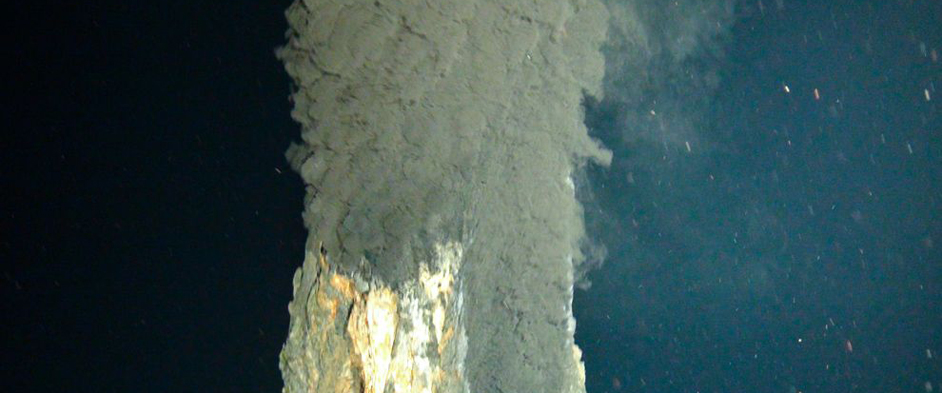
Descending to the deepest point of the Mariana Trench gave scientists an up-close look at an area where two tectonic plates meet.
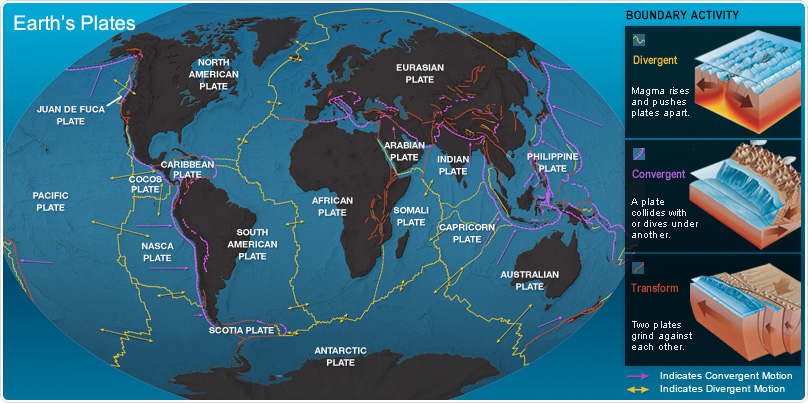
Illustration courtesy National Geographic
Infographic of tectonic plates
When James Cameron descended nearly 7 miles (11 kilometers) into the Challenger Deep, he found a world that seemed very, very still. Living things barely stirred. When he skimmed the sediment on the bottom, sediment as fine as baby powder erupted as if he were entering a basement where dust had been collecting for centuries.
Yet for all its eerie stillness, the deepest parts of the world are incredibly active. These seemingly quiet places can be quite restless – the source of rattling earthquakes and explosive volcanoes. And they might even provide clues to the origins of life.
SEISMIC ACTIVITY
The Mariana Trench is a convergent plate boundary where the Pacific plate to the east is subducting beneath the Philippine plate to the west. One reason the ocean floor seems so smooth at the Challenger Deep, said expedition geologist Patricia Fryer, is because the earth there is always moving. Hundreds of quakes ranging from 4.5 to 8 on the Richter scale have been recorded in the deepest parts of the world’s oceans in the past 50 years. Each time they occur, the super fine sediment on the seafloor is kicked up and slowly redeposited. This redistributed sediment blankets the seafloor—much like a fresh snowfall—and covers any mounds or tracks that living things may have created.
Tectonic activity at plate boundaries in the ocean can also lead to tsunamis. Fryer has incorporated the 3-D footage Cameron captured at the Challenger Deep into her study of tsunamis. Studying the features on the seafloor in the New Britain and Mariana Trenches and comparing them to features seen in other trenches that have produced tsunamis (such as the Japan tsunami in 2011), could eventually reveal clues that help us predict the devastating giant waves.
PILLOW LAVAS
In the New Britain Trench off the coast of Papua New Guinea Cameron encountered an unexpected set of pillow lavas. The mounds of lava, each produced by a small pulse from an underwater eruption, resemble giant squeezes of toothpaste and are the deepest ever found. Their location surprised Fryer.
“Incoming oceanic plates generally don’t expose beautiful sections of pillow lavas like that,” she said. “Usually any rocks exposed there are very altered and covered with sediment.”
But indeed, rather than finding the gentle, sediment-covered slope that Fryer would have normally expected on this oceanic plate, Cameron encountered a slope covered with the smooth formations that almost look comfortable enough to sleep on.
But while they may be fascinating to look at, it’s the potential to study what the pillow lavas are made of that has geologists like Fryer most intrigued. Examining how the composition of the lava has changed over time alongside the distance from its origin could provide clues about how magma formation may be controlled beneath the ocean plate. This means scientists may be able to learn more about the tens of millions of years of history and development of the plate and even its relationship to the formation of volcanic island chains and tectonic processes along its edges that have happened over tens of millions of years.
“Looking at the nature of the ocean crust in trenches is going to help us understand the types of processes that might be related to the generation of earthquakes at the plate margins and the generation of tsunamis,” said Fryer.
SERPENTINIZATION AND THE FIRST LIFE-FORMS
The expedition provided more opportunity for Fryer to study serpentinization, a process that can occur when plates collide in subduction zones like the Mariana Trench.
In subduction, one plate grinds its way under another. Serpentinization occurs when the subducting plate is warmed and squeezed and any water trapped in it—often water is locked into the crystal structure of the rock—is forced up through the plate and toward the ocean floor, causing upper mantle rock to transform along the way. The process releases hydrogen and methane at springs on the seafloor, and some scientists think those gases could have fueled the first life-forms. Serpentinization also creates conditions in the water that help organic molecules stay stable, further evidence, some scientists say, that such a zone might have harbored early life.
So, expedition scientists were thrilled to discover what they call microbial mats in an area where they suspect serpentinization is occurring in the Sirena Deep, a basin east of the Challenger Deep in the Mariana Trench. These 35,100-foot-deep (10,700-meter-deep) clumps of microbes may resemble some of the earliest forms of life. Already biologists have confirmed that these single-celled organisms have genes indicating they can fix carbon dioxide in the dark and feed off of reduced sulfur, necessary ingredients for life in the hadal zones.
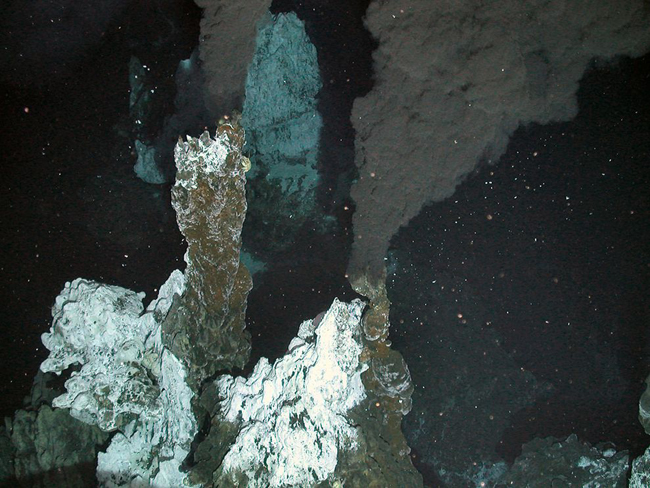
Photograph courtesy NERC CHESSO Consortium
These openings in the Earth’s crust, called black smoker chimneys, can spew mineral-rich water as hot as 720°F (382°C).